Absenteeism
Absenteeism is a pattern of unplanned or habitual absence from work, beyond agreed time off like vacation or public holidays. Occasional sick days are normal. Absenteeism refers to absence that is frequent, unexplained, or rising, and it is often a signal of deeper issues such as burnout, disengagement, health problems, or caregiving pressure.
Also known as: absence rate, employee absenteeism, unplanned absence
Reviewed
Key takeaways
- Absenteeism is the rate of unplanned absence from scheduled work.
- Formula: unplanned absence days ÷ scheduled workdays × 100.
- Count unplanned absences only, not approved leave.
- A spike is usually a symptom (burnout, disengagement, a culture problem), not the disease.
At a glance
- Formula
- Unplanned days ÷ scheduled workdays × 100
- Benchmark
- Often ~1.5–3% depending on sector
- Measured
- Monthly or annually, by team
- Related
- Presenteeism, wellbeing, burnout
Free calculator
Absenteeism rate calculator
Absenteeism rate = unplanned absence days ÷ scheduled workdays × 100. Scheduled workdays = employees × workdays in the period. Count unplanned absences only, not approved leave.
Why does absenteeism matter?
Every unplanned absence pushes work onto teammates, delays projects, and adds overtime cost. Rising absenteeism in one team is often an early sign of a manager or workload problem.
How do you calculate absenteeism?
Absenteeism rate = (days of unplanned absence ÷ total scheduled workdays) × 100
Worked example
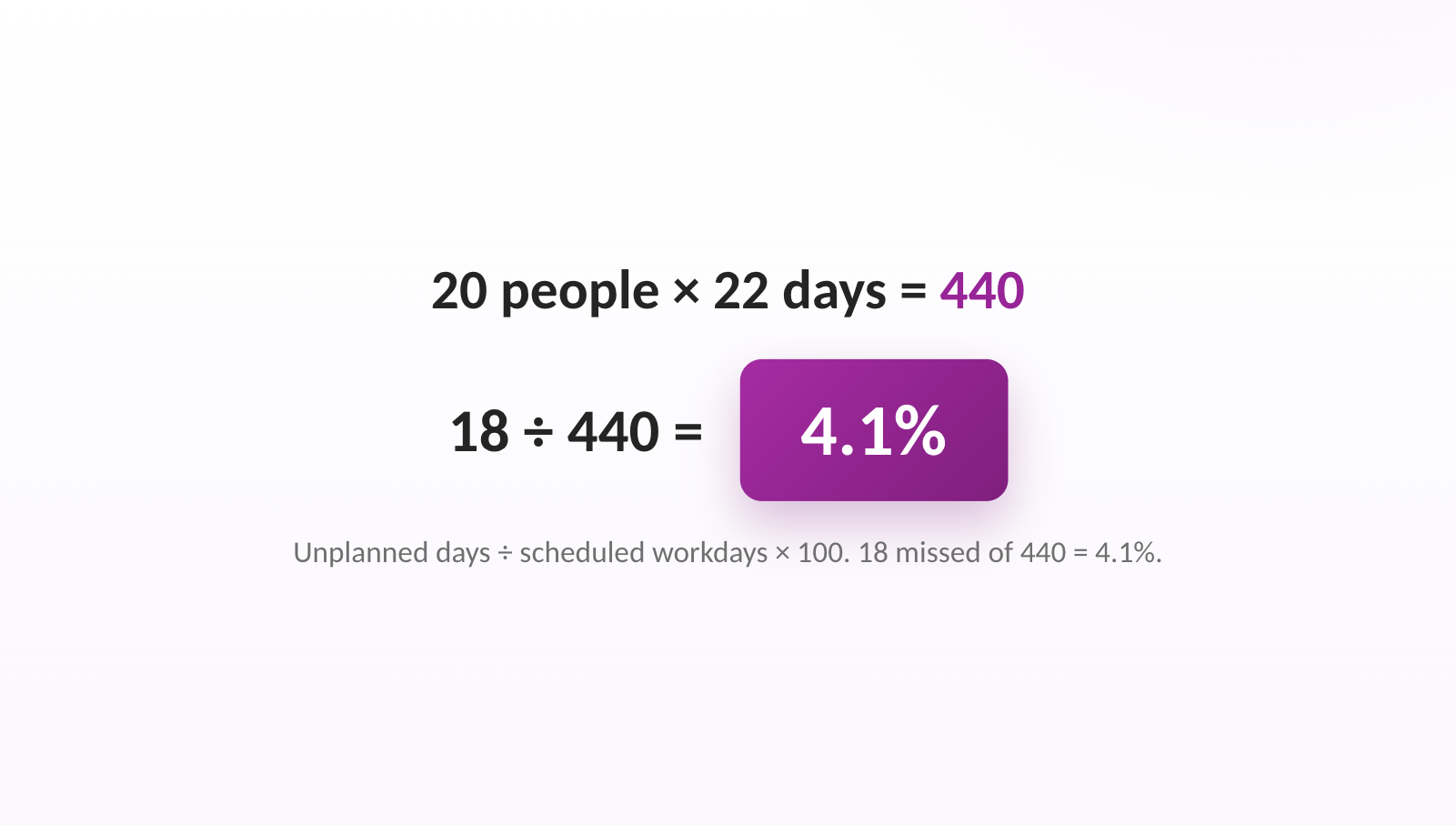
A team of 20 has 22 scheduled workdays in a month, so 440 workdays in total. They log 18 days of unplanned absence.
Absenteeism rate = 18 ÷ 440 × 100 = 4.1%.
What causes absenteeism?
Burnout and heavy workload, low engagement, poor manager relationships, illness, caregiving duties, and lack of flexibility.
How do you reduce absenteeism?
Look at the pattern before the person: which team, which days, which period. Then talk to people early and without blame, offer flexibility where you can, and fix workload issues.
Frequently asked questions
- Absenteeism vs presenteeism?
- Absenteeism is not being at work. Presenteeism is being at work but not able to work effectively, for example because of illness or exhaustion.
- What is the Bradford Factor?
- A formula, S² × D, that weights frequent short absences more heavily than a few long ones. S is the number of separate absences and D is total days absent.
- How do you calculate the absenteeism rate?
- Unplanned absence days ÷ scheduled workdays × 100. For 20 people over 22 workdays, 18 missed days is 18 ÷ 440 = 4.1%.
- What is a good absenteeism rate?
- It varies by industry, but many employers watch for sustained rates above roughly 3%, and for patterns by team or season rather than the raw number.
- What causes high absenteeism?
- Burnout, disengagement, poor management, unclear policies, and health issues. Clusters under one manager or team usually point to a local cause.
- How do you reduce absenteeism?
- Address the drivers (workload, management, wellbeing), make it easy to flag problems early, and track patterns rather than punishing individual days.
See it in practice
Compare employee engagement software
Related terms