Coaching Leadership Style
The coaching leadership style is an approach where a manager focuses on developing people's long-term capability rather than just directing the task in front of them. Coaching leaders ask more than they tell, give regular feedback, and hand people stretch work. It is one of the six leadership styles Daniel Goleman described in his 2000 Harvard Business Review article "Leadership That Gets Results".
Also known as: coaching management style, coaching styles, coaching leadership
Reviewed
Key takeaways
- The coaching leadership style develops people's long-term ability, not just today's task.
- Coaching leaders ask more than they tell and hand out stretch work.
- It is one of Daniel Goleman's six leadership styles.
- It is slower today but frees up far more of a manager's time over a quarter.
At a glance
- Core move
- Ask more, tell less; develop capability
- One of
- Goleman's six leadership styles
- Works when
- People want to grow; roles allow judgement
- Struggles in
- Crises; with people who need clear direction
Why does the coaching leadership style matter?
Directive managers get today's work done. Coaching managers build a team that can do tomorrow's work without them. It is how managers scale beyond their own hours.
When it works, and when it doesn't
Works: people who want to grow, roles with room for judgement, teams with some slack.
Struggles: a crisis that needs fast decisions, people who are new and need clear direction first, or someone who is not open to feedback.
What it looks like day to day
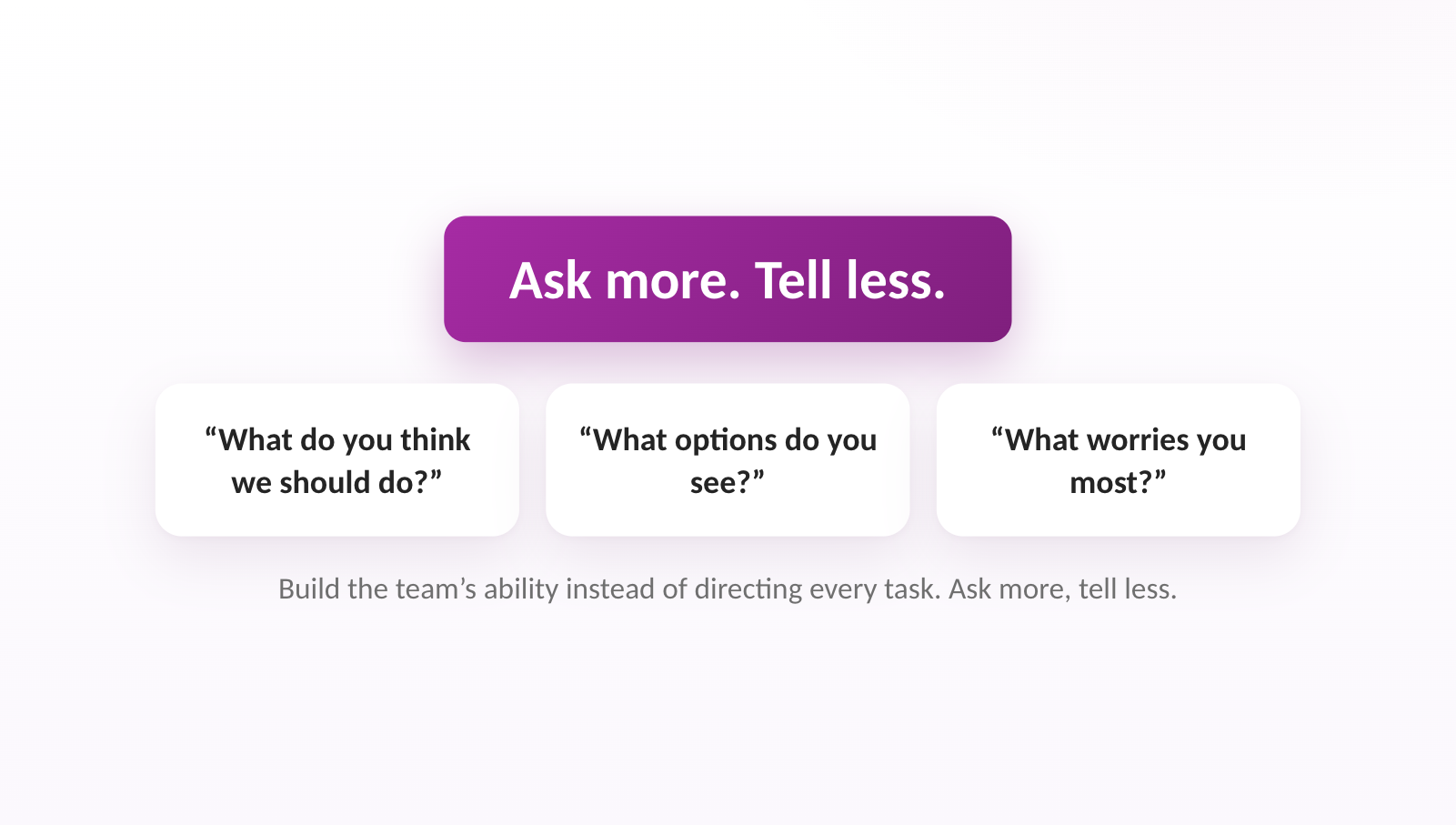
- Asking "What do you think we should do?" before giving an answer
- Using frameworks like GROW in 1:1s
- Delegating outcomes, not steps
- Giving feedback close to the moment
- Agreeing development goals alongside performance goals
Worked example
An engineer asks how to handle a tricky API design. A directive manager sketches the design. A coaching manager asks what options she sees, which trade-offs worry her, and who else has solved something similar. She picks an approach, and next time she does not need to ask.
Frequently asked questions
- What are the six Goleman leadership styles?
- Coercive, authoritative, affiliative, democratic, pacesetting, and coaching. Effective leaders switch between them.
- Is coaching slower?
- In the moment, yes. Over a quarter, it frees up far more of the manager's time.
- What is the coaching leadership style?
- A manager approach focused on developing people's capability through questions, feedback, and stretch assignments, rather than just directing the task.
- What are the benefits of a coaching leadership style?
- It builds capability and confidence, improves retention and engagement, and frees the manager's time as the team grows more self-sufficient, so it pays back over a quarter even though it is slower today.
- When should you not use a coaching style?
- In a crisis that needs fast decisions, or with someone brand new who needs clear direction before they can self-direct.
- What does coaching leadership look like day to day?
- Asking “what do you think we should do?” before answering, using GROW in 1:1s, delegating outcomes not steps, and giving feedback close to the moment.
Sources
- Daniel Goleman, “Leadership That Gets Results,” Harvard Business Review (2000)
See it in practice
Compare performance review software
Related reading
Related terms