Comparison · September 2026
The Best Deel Alternatives for 2026
Eleven honest alternatives to Deel, compared on price, country coverage, and fit: Remote, Multiplier, Oyster, Papaya Global, Velocity Global, Globalization Partners, Rippling, BambooHR, Gusto, Workday, and Sageo.
The verdict
- Best direct EOR alternative
- Remote or Multiplier, Remote owns 100 percent of its entities with no deposit at the same $599 EOR base; Multiplier offers owned-entity EOR from $459, roughly a third cheaper.
- Best for enterprise payroll and compliance
- Papaya Global or Globalization Partners, Papaya adds licensed cross-border payment rails over Workday or SAP; Globalization Partners brings deep compliance advisory for multinationals.
- Best if you needed people development, not payroll
- Sageo, not an EOR: a dedicated performance and development platform that generates a competency framework and runs reviews alongside whatever EOR you use, for EUR 6 per seat.
Bottom line. Deel is a global EOR and payroll platform, so almost every alternative here is another EOR or global-payroll provider: Remote for 100 percent owned entities and no deposit, Multiplier for lower-cost EOR, Oyster for human support, Papaya or Globalization Partners for enterprise payroll and compliance, and Velocity Global's Pebl for AI-first compliance. Sageo is not an EOR; if the piece of Deel you cared about was people development and performance, Sageo runs alongside your EOR.

Deel is the clear market leader in global employment, an all-in-one workforce operating system spanning EOR, global and US payroll, contractor management, and fintech, processing $22 billion-plus in annual payroll across 150-plus countries with a G2 rating around 4.8. So teams rarely leave because it is weak. They leave because EOR at $599 to $899 per employee gets expensive at scale in lower-wage markets, because of FX markups and payment delays, because complex compliance escalations lag, or because they want a provider that owns 100 percent of its legal entities rather than a hybrid partner model.
A note on who wrote this, and how it is organised
Sageo publishes this comparison, and Sageo is one of the eleven products in it. The most important honest point on this page: Deel is a global EOR and payroll platform, and Sageo is not. Sageo does not employ people, run payroll, or handle cross-border compliance. So almost every alternative here is another EOR or global-payroll provider that can genuinely replace Deel, and Sageo appears only for the narrow case where the piece of Deel you cared about was people development and performance, not payroll. We say plainly which is which. Every figure comes from vendor pricing pages, G2, Capterra, and public data as of September 2026; every Sageo claim comes from sageo.ai. Section 6 covers when to just stay on Deel.
1. Which Deel alternative should you choose?
Start by naming what pushed you off Deel: EOR cost at scale, the entity model, enterprise payroll and treasury needs, or the fact that you never really needed EOR at all. Match the reason to the shortlist below.
Quick picks
| If you are leaving Deel because... | Look at | Why |
|---|---|---|
| You want a direct EOR rival with 100 percent owned entities and no deposit | Remote | Owns all its legal entities for uniform IP protection and compliance, at the same $599 EOR base, with no security deposit. |
| EOR at scale is too expensive and you want predictable, lower pricing | Multiplier | Owned-entity EOR from $459 across 150-plus countries, roughly a third below Deel, strong in APAC. |
| You want dedicated human legal and HR experts, not ticket queues | Oyster | A B Corp EOR with in-house specialists, competitive benefits benchmarking, and a $29 contractor rate. |
| You are an enterprise that needs global payroll orchestration and treasury | Papaya Global | Enterprise payroll across 160-plus countries with a licensed cross-border payments rail, built to sit over Workday or SAP. |
| You want an enterprise EOR incumbent with white-glove compliance advisory | Globalization Partners | A long-established EOR for compliance-heavy multinationals, with deep SAP, Workday and UKG integrations. |
| You want AI-first compliance and strong owned-entity coverage | Velocity Global (Pebl) | EOR across 185-plus countries with the Alfie AI compliance engine and about 90 percent owned-entity coverage. |
| You are scaling and want to unify HR, IT and payroll, with EOR included | Rippling | A workforce operating system spanning HR, payroll, IT device management and global payroll and EOR. |
| The piece of Deel you actually needed was people development, not payroll | Sageo | Not an EOR. It is a performance and development platform that generates a competency framework from your values and runs reviews, alongside whatever EOR or payroll you use. €6 per seat. |
2. Why do teams look for a Deel alternative?
Five reasons come up again and again in reviews and buyer conversations. None mean Deel is a poor product, it is the category leader for good reasons. They mean its model and pricing suit a particular kind of buyer, and if that is not you, the fit gets expensive or misaligned.
- EOR cost at scale
- The $599 per employee EOR base, which can run up to $899 depending on country and volume, becomes expensive as you scale larger teams in lower-wage emerging markets. Owned-entity rivals like Multiplier start around $459, and Velocity Global runs a $399 promotional rate.
- FX spreads and payment timing
- Cross-border payments carry FX markups typically 0.5 to 2 percent above interbank rates, and buyers report occasional friction on transfer timelines and secondary wire charges.
- Escalation delays
- Routine support is responsive, but complex legal, tax, and local-payroll escalations can stall because they depend on multiple jurisdictions at once.
- A hybrid entity model
- Deel owns entities in 100-plus countries but relies partially on third-party partners in long-tail markets. Rivals such as Remote (100 percent owned) use that contrast to pitch more uniform compliance and IP protection.
- The upfront deposit
- EOR onboarding requires a refundable security deposit of about one month of salary plus statutory costs, a working-capital hit that deposit-free providers like Remote and Papaya's contractor product avoid.
The pattern. Deel fits companies of any size that need to hire, pay, and stay compliant across borders quickly, with the broadest coverage and the deepest fintech and IT tooling. If you are cost-sensitive at scale, want a fully owned entity model, need enterprise payroll orchestration, or never really needed EOR, the alternatives below tend to fit better, and almost all of them are other global-employment providers.
3. How do you choose between them?
Three questions cut the field faster than a feature checklist.
Do you actually need EOR, or just contractor payments?
EOR (employing someone through the provider's legal entity) is the expensive part. If you only pay international contractors, the contractor products are far cheaper, Remote and Oyster at $29, Multiplier at $40, versus $49 on Deel. If you employ people abroad, you need a full EOR, and the entity model and country coverage below matter most.
Owned entities or a partner network?
This is the compliance and IP question. Remote owns 100 percent of its entities; Velocity Global owns about 90 percent; Multiplier and Oyster are largely owned with partners in some markets; Deel, Papaya, and Globalization Partners run hybrid owned-plus-partner models. Owned entities give more uniform compliance and a cleaner IP chain; partner networks can reach more long-tail countries.
Are you buying employment, or performance?
Be honest about which part of Deel you are replacing. If it is the employment and payroll, everything above applies. If your team has expanded into people development, performance reviews, goals, and growth, and that is the gap, that is a different category entirely, and a dedicated performance platform like Sageo runs alongside your EOR rather than replacing it.
4. What do the Deel alternatives cost?
EOR base rates, contractor fees, and entity models, from vendor pricing pages and buyer-reported data as of September 2026. Per employee per month unless noted. Statutory employer taxes and benefits are billed on top as pass-throughs everywhere.
| Product | EOR base | Contractor | Countries / entity model | G2 |
|---|---|---|---|---|
| Deel | $599 (up to $899) | $49 | 150+, hybrid owned + partner | ~4.8 |
| Remote | $599 annual / $699 monthly | $29 | 90+ EOR, 100% owned | 4.5 |
| Multiplier | $459 (Growth $519) | $40 | 150+, owned | 4.7 |
| Oyster | $699 | $29 | 120+ EOR, owned + partners | 4.4 |
| Papaya Global | $499 to $599 | $5 to $30 mgmt | 160+, aggregator + owned | 4.5 |
| Velocity Global (Pebl) | $399 promo / $599 standard | Custom | 185+, ~90% owned | 4.6 |
| Globalization Partners | From $599 (custom) | Tiered | 180+, hybrid owned + partner | 4.4 |
| Rippling | Global payroll from $29; EOR add-on | $8 + $35/mo base | 185+, unified HR/IT/payroll | 4.8 |
| BambooHR | No EOR (US HRIS) | n/a | US payroll only | 4.4 |
| Gusto | No EOR; EOR via partner | $35/mo | US payroll; contractors 120+ | 4.6 |
| Workday HCM | No EOR (enterprise HCM) | n/a | Global via partners | 4.2 |
| Sageo | Not an EOR | n/a | Performance layer, €6/seat | New |
5. Each Deel alternative in depth
Eleven products, each in the same format: what it is, why you would pick it over Deel, its core features, and what users praise and warn about. The global-employment providers that can replace Deel come first, then broader HR platforms, and finally Sageo, for the specific case where performance, not payroll, was the real need.
 Remote
Remote is owned-entity global employment infrastructure: 100 percent owned legal entities for maximum IP protection, transparent flat pricing, and no security deposits. It is Deel's most direct philosophical rival.
Why choose it over Deel. Remote's core contrast with Deel is the entity model: it owns all of its entities, where Deel runs a hybrid owned-plus-partner network in long-tail markets, so Remote pitches uniform compliance and a cleaner IP chain (Remote IP Guard). It matches Deel's $599 EOR base but charges no security deposit and a lower $29 contractor rate. Deel wins on broader coverage and richer fintech and IT tooling.
- Category
- Owned-entity global EOR, payroll, and contractor management
- Best fit
- IP-sensitive tech and multi-country teams, startup to enterprise
- Pricing
- EOR $599 annual ($699 monthly), contractor $29, global payroll $29; no deposit
- vs Deel
- 100 percent owned entities and deposit-free; narrower coverage and fintech
Key features
100 percent owned legal entities across 90-plus EOR markets, with contractor reach to 170-plus countries
Remote IP Guard for an unbroken IP-assignment chain of custody
Modular products
EOR, global payroll, contractor management, US PEO, and Remote Equity via Carta.
A free HR Core tier, plus recruiting through Remote Talent, and no mandatory security deposits
What users say
Praised
- Intuitive UI and a compliant contract engine; 4.5 on G2 across 5,000-plus reviews.
- Owned-entity IP security and a deposit-free model.
Watch out for
- Ticket-based support can lag on tax disputes and offboarding.
- Strict payroll cutoffs push missed items to the next cycle.
 Multiplier
Multiplier is a mid-market global employment platform offering owned-entity EOR at roughly a third below premium rivals, with flat, predictable per-seat pricing. It is Singapore-headquartered and strong in APAC.
Why choose it over Deel. Multiplier claims the same 150-plus country owned-entity footprint as Deel but at a materially lower cost: EOR from $459 versus $599, and contractors at $40 versus $49, with no hidden onboarding fees or mid-contract price adjustments. For a cost-conscious mid-market team, especially expanding in APAC, it is the value play. Deel wins on ecosystem breadth and brand scale.
- Category
- Mid-market owned-entity global EOR and payroll
- Best fit
- 51 to 1,000 employees expanding into 3 to 15 markets, APAC-strong
- Pricing
- EOR Core $459 (Growth $519), contractor $40, global payroll $20; billed annually
- vs Deel
- About a third cheaper EOR at similar coverage; smaller ecosystem
Key features
EOR across 150-plus countries via owned entities, with 24-hour onboarding
Global payroll in 100-plus countries and 120-plus currencies at 99.95 percent accuracy
Contractor management and Contractor of Record for high-risk jurisdictions
A global HRIS with document repository, org charts, leave, expenses, and device provisioning
What users say
Praised
- Fast onboarding, owned entities, and flat transparent pricing; 4.7 on G2.
- Responsive named account managers and strong compliance scores.
Watch out for
- A limited integration marketplace; enterprise stacks need custom API work.
- Rigid contract customisation and occasional peak-cycle wire delays.
 Oyster
Oyster is a Certified B Corp EOR that blends digital onboarding with dedicated in-house human legal and HR experts, plus country-competitive benefits benchmarking. It leans mission-driven and mid-market.
Why choose it over Deel. Oyster's differentiator is human support: dedicated legal and HR specialists per account, rather than Deel's automated ticket and AI queues, plus a lower $29 contractor rate and benefits benchmarking built into the base. It is a strong pick for first-time global expanders who want guidance over IT breadth. Its EOR base of $699 is higher than Deel's $599.
- Category
- Mid-market, mission-driven global EOR and contractor management
- Best fit
- Remote-first and mission-driven teams hiring internationally
- Pricing
- EOR $699, contractor $29 (free 30 days), global payroll $25 to $29; one-month deposit
- vs Deel
- Human legal and HR experts and lower contractor cost; higher EOR base
Key features
EOR with 48-hour onboarding across 120-plus markets, plus $8 million-plus liability protection
Contractor management in 180-plus countries with a misclassification analyzer and optional insurance
Global payroll direct in 20-plus countries, plus the Pearl AI hiring assistant
B Corp impact programs
startup subsidies, nonprofit discounts, and a refugee talent initiative.
What users say
Praised
- Fast onboarding and responsive account managers plus regional legal specialists; 4.4 on G2 across 1,040-plus reviews.
- Ethical benefits and a strong self-service experience.
Watch out for
- Service variance in some APAC markets that rely on partners.
- Basic analytics, a one-month deposit, and no native mobile app.
 Papaya Global
Papaya Global is an enterprise workforce operating system that unifies global payroll orchestration with a licensed B2B cross-border payments rail. It is built as an overlay for enterprises already running Workday, SAP, or Oracle.
Why choose it over Deel. For a finance-driven enterprise, Papaya is less an EOR and more a payroll and treasury platform: standardised payroll across 180-plus countries plus its own licensed payment rails (Payments OS), which sidestep the FX markups buyers dislike on Deel. Its EOR entry is lower at $499. Deel wins on owned entities, self-serve speed, and lower contractor rates.
- Category
- Enterprise global payroll orchestration, EOR, and payments
- Best fit
- Large multinationals running Workday, SAP, or Oracle across many countries
- Pricing
- EOR $499 to $599, payroll from $29 (scaling to $15), Payments OS $2.50 to $3.50 per transaction
- vs Deel
- Licensed payment rails and deep ERP data modelling; enterprise-only
Key features
Global payroll across 180-plus countries with a reconciliation and differences-breakdown engine
Payments OS
direct-bank rails across 160-plus countries with 95 percent same-day delivery.
Embedded AI for worker classification, journal-entry config, and biometric KYC onboarding
Deep connectors for Workday, SAP SuccessFactors, Oracle, and NetSuite
What users say
Praised
- Centralised multi-country visibility and strong payroll reporting; 4.5 on G2.
- Owned treasury and payment rails, and dedicated account managers.
Watch out for
- Reliance on in-country partners in some markets, and rigid payroll cutoffs.
- High baseline cost with no free trial; not for small businesses.
 Velocity Global (Pebl)
Pebl, the platform Velocity Global rebranded to in 2025, is an AI-first global employment platform that pairs owned-entity infrastructure with the Alfie AI compliance engine, trained on over a decade of proprietary legal and tax data.
Why choose it over Deel. Pebl differentiates on AI-driven compliance and about 90 percent owned-entity coverage across 185-plus countries, with a $399 promotional EOR rate that undercuts Deel's $599. Its Alfie engine gives instant compliance answers and contract drafting. Deel counters with more self-serve automation, developer APIs, and a broader fintech and contractor toolset; note Pebl's add-on fees can inflate the effective cost.
- Category
- AI-first global EOR, payroll, and mobility
- Best fit
- Venture-backed startups to Fortune 500 scaling international headcount fast
- Pricing
- EOR $399 promotional, $599 standard; visas and advisory about $3,000 per block; custom contractor
- vs Deel
- Alfie AI compliance and ~90 percent owned entities; less self-serve automation
Key features
EOR across 185-plus countries and all US states, with 65 owned entities covering about 90 percent of workforce
The Alfie AI engine for instant compliance answers, cost estimates, and contract drafting in 50-plus languages
Global payroll at 99.9 percent accuracy, plus international equity administration
Global mobility and visas with a 95 percent-plus approval rate and an in-house immigration team
What users say
Praised
- Strong compliance and legal risk mitigation; 4.6 on G2 across 600-plus reviews.
- Intuitive UI and flexible off-cycle payroll.
Watch out for
- A sharp buyer-versus-worker rating split and worker-side support complaints.
- Add-on fee opacity and no published pricing transparency.
 Globalization Partners (G-P)
Globalization Partners is an established enterprise EOR incumbent for compliance-heavy multinationals, with deep regulatory expertise, white-glove advisory, and the G-P Meridian SaaS suite. It predates most of the newer platforms.
Why choose it over Deel. G-P is the choice when compliance depth and enterprise advisory matter more than self-serve speed: decades of regulatory experience, dedicated legal and HR advisors, M&A and workforce-transition support, and certified SAP, Workday, and UKG integrations. Deel is faster and more automated with more transparent pricing; G-P is slower to onboard (5 to 15 days) and quote-based.
- Category
- Enterprise global EOR with compliance advisory
- Best fit
- Mid-market and enterprise needing full compliance risk transfer and M&A support
- Pricing
- EOR from $599 (custom enterprise quote); one-month deposit; tiered contractor management
- vs Deel
- Deeper compliance advisory and enterprise HCM integrations; slower and pricier
Key features
EOR across 180-plus countries via a hybrid owned-entity and vetted-partner network
The G-P Meridian suite (Core, Prime, Select) spanning payroll, advisory, contractors, and mobility
G-P Gia agentic AI compliance advisor across 50-plus countries and all US states
Certified integrations for SAP SuccessFactors, Workday, UKG, ADP, and BambooHR
What users say
Praised
- Deep regulatory knowledge and dedicated specialists; 4.4 on G2 across 1,000-plus reviews.
- Strong enterprise security and legal-liability offloading.
Watch out for
- Slow onboarding of 5 to 15 business days and a dated admin UI.
- Higher total cost and complex tiering versus basic EOR vendors.
 Rippling
Rippling is a unified workforce operating system that combines HR, IT, and Finance on a single Employee Graph, including global payroll and EOR. It is the broadest platform here beyond employment alone.
Why choose it over Deel. Rippling is the pick when global employment is only part of what you need: it also runs IT device management, identity, and spend on the same system, which Deel does not match at that depth. For a scaling company consolidating its whole back office, it does more; Deel remains the more focused, deeper global-employment specialist with broader owned coverage.
- Category
- HR, IT, and Finance suite with global payroll and EOR
- Best fit
- 20 to 1,000 employees consolidating HR, IT, and payroll while going global
- Pricing
- Core $8 per employee plus $35/month base; global payroll from $29; EOR as an add-on
- vs Deel
- Adds IT and finance on one system; less specialised as a pure EOR
Key features
Core HRIS on an Employee Graph, plus full-service payroll and global payroll across 185-plus countries
IT Cloud
identity with SSO and MFA, app provisioning, and device management.
Finance Cloud
expense management, corporate cards, and bill pay.
A compound automation engine, App Studio low-code, and 650-plus integrations
What users say
Praised
- Eliminates duplicate data entry across HR, IT, and finance; 4.8 on G2 across 16,000-plus reviews.
- 90-second onboarding and strong employee experience.
Watch out for
- Modular add-ons compound quickly, so true cost is hard to forecast.
- Ticket-only support, and some international compliance edge cases lag.
 BambooHR
BambooHR is a purpose-built core HRIS for small and mid-sized businesses, with native US payroll and a clean, easy interface. It is not an EOR, so it belongs here only for teams whose real need is a US system of record rather than global employment.
Why choose it over Deel. If your workforce is really US-based and you were using Deel mainly as an HR system of record, BambooHR is a purpose-built US HRIS with native payroll and far more HR depth (ATS, onboarding, culture tools). It cannot hire or pay employees abroad, so pair it with an EOR like Remote if you also employ internationally.
- Category
- SMB core HRIS (US), not an EOR
- Best fit
- 25 to 500 US-based employees wanting a full HR system of record
- Pricing
- Core about $10, Pro about $17, Elite about $25 per employee; US payroll add-on
- vs Deel
- Deeper US HR and system of record; no global employment or EOR
Key features
Core employee database and self-service portal, with document management and e-signatures
ATS and offer management, plus automated onboarding and offboarding
PTO and time tracking, native US payroll, and benefits administration
Lightweight performance and People Analytics with 49 standard reports
What users say
Praised
- Clean, intuitive UI with rapid adoption; 4.4 on G2 across 6,700-plus reviews.
- Strong self-service portal and non-technical reporting.
Watch out for
- Native payroll is US-only; no international employment.
- Quote-only pricing and a mandatory setup fee.
 Gusto
Gusto
Gusto is an SMB-first US payroll, benefits, and HR platform. It pays international contractors in 120-plus countries and offers EOR through a partner, but it is fundamentally a US payroll product, not a global employment platform.
Why choose it over Deel. For a small, mostly US team that also pays a few overseas contractors, Gusto is simpler and cheaper than a global EOR: transparent pricing, superb US payroll, and contractor payments abroad. It is the pick when Deel was overkill for a predominantly domestic team; for actual international employment, you still need an EOR.
- Category
- SMB US payroll-first with global contractor payments
- Best fit
- 1 to 75 mostly US employees with some international contractors
- Pricing
- Simple $49/month + $6/employee; contractor-only $35/month + $6; EOR via Remote partner
- vs Deel
- Simpler and cheaper for US-centric teams; not a true global EOR
Key features
Full-service US payroll with automated federal, state, and local tax filing
Benefits
health, dental, vision, and 401(k), as a licensed broker.
International contractor payments in 120-plus countries, with EOR via a partner
Core HR, onboarding, and native time tracking with geofencing
What users say
Praised
- Market-leading ease of use; 4.6 on G2 across 14,000-plus reviews.
- Automated tax filing and tight accounting sync.
Watch out for
- Fundamentally US-centric; EOR is via a partner, not native.
- Cost compounds past 50 employees.
 Workday HCM
Workday HCM is an enterprise Human Capital Management platform unifying HR, talent, payroll, and planning on one data model. It reaches globally through partners rather than acting as an EOR, so it fits large enterprises consolidating on one system of record.
Why choose it over Deel. Workday is for enterprises that want their global workforce inside a single, deep system of record, with analytics and planning Deel does not attempt. It is not an EOR, so global hiring runs through partners (including EOR providers). The trade is enterprise cost and a heavy implementation; it only makes sense at 1,000-plus employees.
- Category
- Enterprise HCM suite (system of record), not an EOR
- Best fit
- 1,000+ employee global enterprises with dedicated HRIS teams
- Pricing
- Negotiated; roughly $90 to $130 per employee per year, plus heavy implementation
- vs Deel
- Deep enterprise system of record and analytics; global hiring via partners
Key features
Core HR on a single object-oriented data model, with global org hierarchies
Talent management
Skills Cloud, goals, reviews, and succession.
Payroll and advanced compensation, with global coverage via partners
5,000-plus prebuilt reports and Workday Illuminate agentic AI
What users say
Praised
- A single data architecture with strong integrity and deep global compliance.
- Native drag-and-drop reporting.
Watch out for
- Interface complexity and cost make it overkill below enterprise scale.
- It is not an EOR; you still need a partner to employ people abroad.
Sageo (the performance layer)
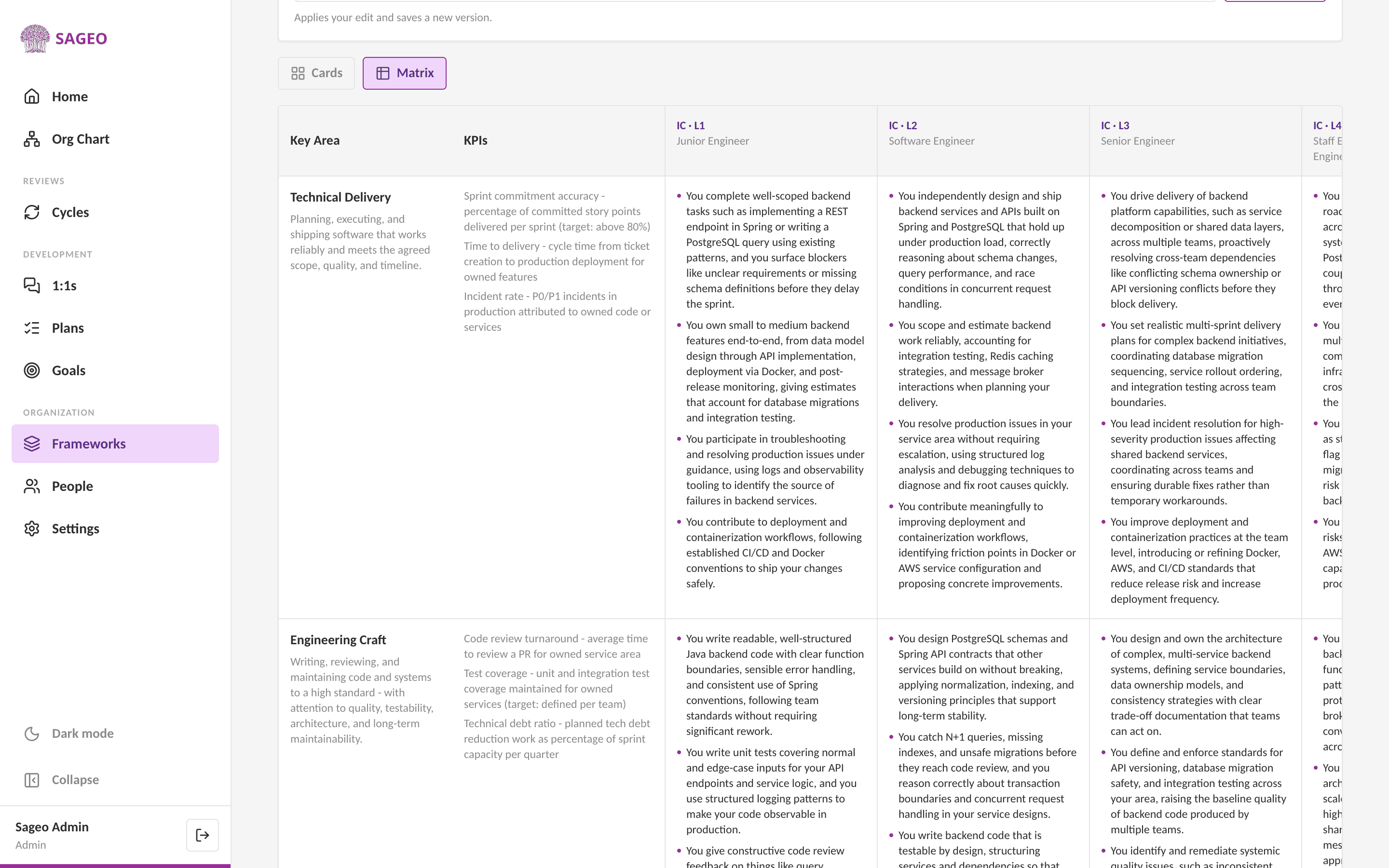
Sageo is a culture-first performance platform for companies of 10 to 1,000 people, built on the principle "The AI drafts. Your people decide." It is the one product in this comparison that is not a global-employment tool at all. It does not employ, pay, or handle compliance for anyone, so it cannot replace Deel's core.
Where Sageo actually fits. Deel has expanded well beyond payroll into HR and people-development tooling, including its performance and development suite, Deel Engage. If that people-development layer, reviews, goals, and growth, is the part of Deel you actually cared about, rather than the employment infrastructure, Sageo is a dedicated alternative for it. It turns your company values into a competency framework and runs calibrated reviews, development plans, and 1:1s, and it runs happily alongside Deel or any other EOR for €6 per seat.
- Category
- Performance and development platform (not an EOR or payroll tool)
- Best fit
- 10 to 1,000 employees wanting real performance depth, on top of any EOR or HRIS
- Pricing
- €6 per seat per month, every module, annual, 10-seat minimum. No floor, no setup fee.
- vs Deel
- Replaces the people-development side only; runs alongside your EOR, not instead of it
Key features
AI competency framework generator
converts values and levels into IC and manager expectations, level by level.
Calibrated 360 reviews
self, manager, peer, and upward, with an immutable audit log for every score change.
360 reports for managers and skip-levels, and a blended result each employee sees once calibration closes
AI development plans, monthly 1:1s, and feedback and recognition tagged to values
Private-by-design AI
names and identifiers are stripped before any LLM call.
What users say
Praised
- Speed from values to a working framework, in about an hour.
- Flat, all-inclusive pricing with no floor or setup fee.
Watch out for
- It is not an EOR or payroll platform, no employment or compliance.
- Young product without a large review footprint yet.

See how Sageo actually works
An interactive walkthrough of frameworks, 360 reviews, calibration, and monthly 1:1s.
Explore the Walkthrough6. When should you just stay on Deel?
Migrating global employment is high-risk, because it touches live contracts, payroll, and compliance in multiple countries, so it is worth being honest about when Deel remains the right answer. Stay if most of these describe you.
- You need the broadest country coverage and the fastest self-serve onboarding available.
- You value Deel's depth of fintech and IT tooling, from the Deel Card to global device logistics.
- You want contractors, EOR employees, entity payroll, IT, and visas managed in one portal.
- Your volumes let you negotiate Deel's EOR rate down toward the $350 to $400 range.
- The hybrid entity model and standard deposit are acceptable trade-offs for its scale and ecosystem.
The short version
Stay on Deel if you want the broadest, most automated global-employment platform. Move to Remote for 100 percent owned entities and no deposit, Multiplier for lower-cost EOR, Oyster for human support, Papaya or Globalization Partners for enterprise payroll and compliance, and Velocity Global's Pebl for AI-first compliance. And if the part of Deel you actually needed was performance and development, add Sageo alongside whatever EOR you choose.
7. How this comparison was researched
Every Deel and competitor figure in this comparison comes from vendor pricing pages, public procurement records, and review sites including G2 and Capterra, as of September 2026. Ratings are current vendor averages at the time of writing and change over time. Every Sageo claim comes from sageo.ai. EOR and payroll prices are shown per employee per month unless noted, before statutory employer costs, which every provider bills as pass-throughs; several vendors quote enterprise deals only on request, in which case we use buyer-reported ranges. Sageo is priced in euros and is a performance platform rather than a global-employment tool. Where a vendor's own materials cite a competitor's price, we defer to that competitor's official pricing.
Frequently asked questions
What is the best alternative to Deel?
It depends on why you are leaving. For a direct EOR with 100 percent owned entities and no deposit, Remote; for lower-cost EOR, Multiplier; for human legal and HR support, Oyster; for enterprise payroll orchestration, Papaya Global; for compliance-heavy multinationals, Globalization Partners; and for AI-first compliance, Velocity Global's Pebl. If you never really needed EOR and only wanted people development, Sageo is a dedicated performance platform that runs alongside any of them.
Why do companies leave Deel?
The common reasons are EOR pricing at scale (the $599 base runs up to $899 and is expensive in lower-wage markets), FX markups of 0.5 to 2 percent on cross-border payments, occasional payment and escalation delays on complex compliance cases, a hybrid owned-plus-partner entity model in long-tail markets, and an upfront security deposit of about one month of salary. Deel remains excellent on coverage and automation, so these are fit issues, not quality issues.
What is the cheapest Deel EOR alternative?
Among owned-entity EOR providers, Multiplier is the lowest at $459 per employee (versus Deel's $599), and Velocity Global's Pebl runs a $399 promotional rate. If you only pay international contractors rather than employ them, Remote and Oyster charge $29 per contractor and Multiplier $40, all below Deel's $49.
Does Deel own all its legal entities?
No. Deel owns entities in 100-plus countries but relies partly on third-party partners in long-tail markets, a hybrid model. If a fully owned entity network matters for compliance uniformity and IP protection, Remote owns 100 percent of its entities and Velocity Global owns about 90 percent, while Papaya and Globalization Partners also run hybrid models.
Is Sageo a Deel alternative?
Not for Deel's core. Sageo is not an EOR and does not employ people, run payroll, or handle cross-border compliance, so it cannot replace Deel's global-employment infrastructure. Where it fits is the people-development side: if what you used from Deel was performance and development (such as Deel Engage), Sageo is a dedicated performance platform that generates a competency framework and runs calibrated reviews, alongside whatever EOR you keep.
Product names and logos are trademarks of their respective owners, shown here for identification only and not as endorsements.
All comparisons